- AUTOMATION EQUIPMENT
- DIGITAL CONTROL
- ELECTRICAL ITEMS
- AMPLIFIER & UPS
- BATTERY CHARGER & INVERTER
- CIRCUIT BREAKER & BLOCKS
- CONTROL UNIT
- ELECTRIC CONTROLLERS
- FIRE ALARAM SYSTEM
- FUSES & CAPACITOR
- HEADPHONE & SPEAKER
- HMI & DISPLAY
- MISC ELECTRICAL
- PCB
- PLC SYSTEMS
- POWER SUPPLY
- PRINTER & CPU
- RELAY
- SENSORS
- SERVO DRIVES & MOTORS
- TELECOME & COMMUNICATION
- THERMOSTAT
- MACHINERY
- SENSORS
- UNCATEGORIZED





Hotline Order:
(+91) 97257 54777
Email ID:
shipnavstore@gmail.com

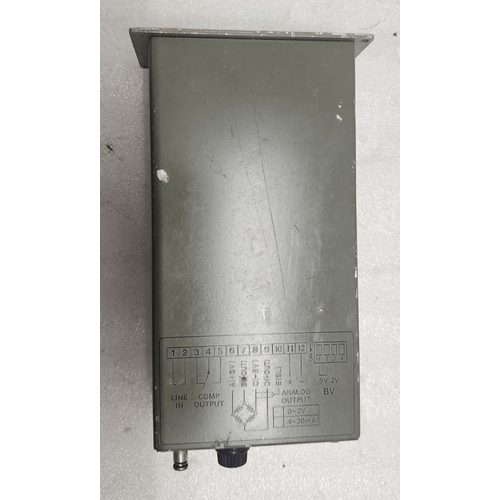
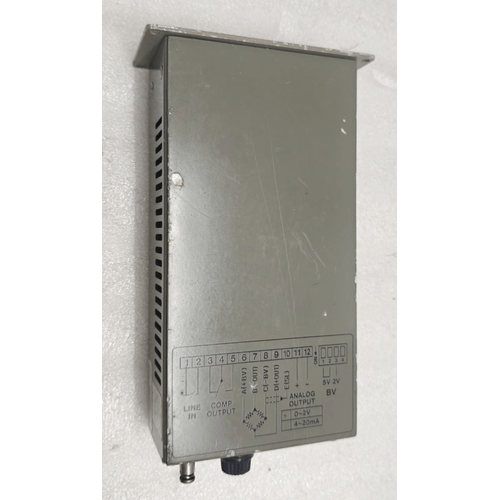
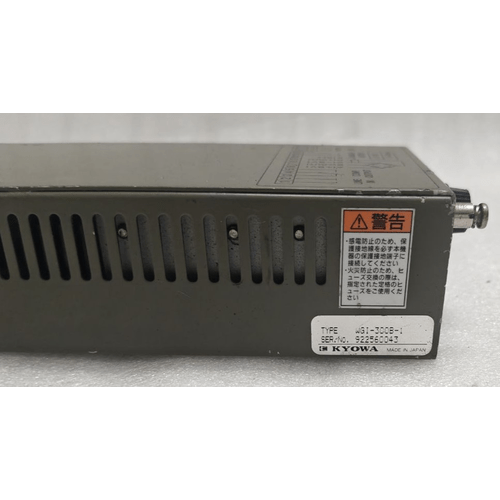
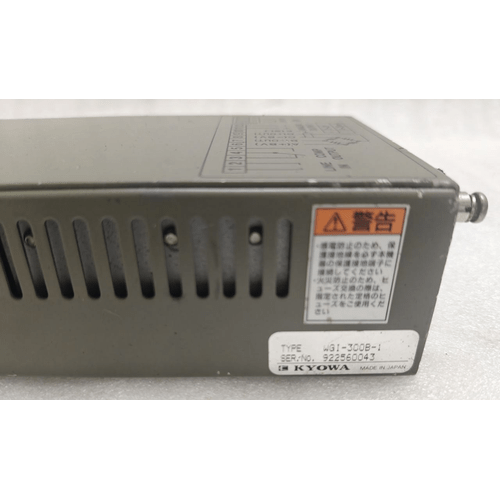
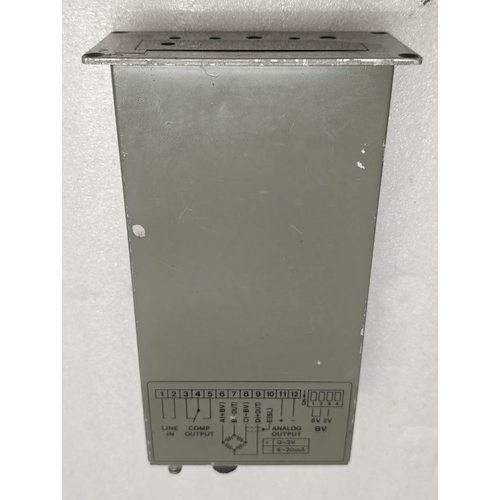
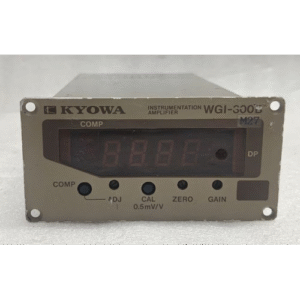
KYOWA WGI 300B-1 JAPAN USED INSTRUMENTATION AMPLIFIER 16:41
₹16,979.00
| Product Conditioned | USED |
|---|
This is a used, high-precision, Japanese-made instrumentation amplifier designed for conditioning weak signals from sensors in scientific and industrial measurement systems. Its value is entirely dependent on finding its documentation and verifying its functionality for a specific niche application.
Free Shipping apply to all orders over $199
Guaranteed Money Back in 30 days return.
24/7 Customer Support
Share:
 KYOWA WGI 300B-1 JAPAN USED IN...
₹16,979.00
1 in stock
Hotline Order:
(+101) 5620 - 8155
Email ID:
xstore@support.com
The KYOWA WGI-300B-1 is a precision Instrumentation Amplifier manufactured by KYOWA Electronic Instruments Co., Ltd., a renowned Japanese company specializing in precision measurement equipment, including strain gauges, sensors, and signal conditioning electronics.
This unit is a critical component in data acquisition and measurement systems. Its primary function is to amplify a very small differential voltage signal (often from a sensor like a strain gauge, load cell, or thermocouple) while rejecting any common-mode noise (interference that appears on both signal wires). This makes the signal stronger, cleaner, and suitable for processing by a data logger, oscilloscope, or analog-to-digital converter (ADC).
The “USED” designation indicates this is a previously owned unit, likely sourced from surplus or decommissioned industrial or research equipment.
Key Specifications (General for WGI-300 Series)
-
Manufacturer: KYOWA (Japan)
-
Model: WGI-300B-1 (This specific variant indicates certain factory-set parameters like gain range and filter settings).
-
Type: Instrumentation Amplifier (Conditioning Amplifier)
-
Condition: USED
-
Country of Origin: Japan
Key Features and Functions
-
High-Gain, Low-Noise Amplification: Designed to accurately amplify very weak millivolt (mV) signals from sensors without adding significant electrical noise.
-
Excellent Common-Mode Rejection Ratio (CMRR): This is its most important feature. It effectively cancels out noise interference that is common to both input lines, which is crucial for accurate measurements in electrically noisy industrial environments.
-
High Input Impedance: Draws minimal current from the sensor source, preventing the amplifier from “loading” the sensor and affecting the measurement accuracy.
-
Adjustable Parameters (Typical for such units):
-
Gain: The amplification factor is often selectable via DIP switches or a rotary switch on the unit (e.g., x10, x100, x1000).
-
Filtering: Includes low-pass filters to remove high-frequency noise from the signal.
-
Excitation Voltage: May provide a stable DC voltage or AC carrier signal to power the connected sensor (e.g., a strain gauge bridge).
-
-
Bridge Completion: Often includes resistors to complete a Wheatstone bridge circuit for strain gauge-based sensors.
-
Rack-Mountable Design: The WGI-300 series units are typically designed to be mounted in a standard 19-inch equipment rack, making them ideal for permanent test bench or laboratory setups.
Common Applications
This amplifier was used in precision measurement and testing scenarios, such as:
-
Structural Testing: Measuring stress and strain on beams, frames, and materials using strain gauges.
-
Vibration Analysis: Conditioning signals from accelerometers.
-
Force Measurement: Used with load cells in research, development, and quality control.
-
Automotive and Aerospace Testing: Data acquisition from various sensors during component and full-scale testing.
-
University and Research Laboratories: General-purpose signal conditioning for physics and engineering experiments.
Important Notes for Potential Use
-
Not a General-Purpose Amplifier: This is a highly specialized, precision instrument for measurement applications. It is not suitable for audio or general electronic projects.
-
Manual Required: To use this unit effectively, you must find the official KYOWA WGI-300 series operation manual. The manual is essential to understand:
-
The meaning of the “B-1” suffix and its factory configuration.
-
The pinout of the input and output connectors.
-
How to set the gain, filters, and excitation voltage.
-
Calibration procedures.
-
-
Verified Functionality: As a used unit, its functionality should be verified before reliance on its measurements. Components like potentiometers for calibration can degrade over time.
-
Power Requirements: It will require specific AC or DC power supplies, details of which will be in the manual.
-
Obsolescence: This is a legacy piece of equipment. While often very well-built, finding technical support or repair services may be difficult.
We're here when you need us
Get a Quick Quote
Complete our online form.
Call US
Speak to one of our team.
Live Chat
Send us a message
Speak to one of our team.