- AUTOMATION EQUIPMENT
- DIGITAL CONTROL
- ELECTRICAL ITEMS
- AMPLIFIER & UPS
- BATTERY CHARGER & INVERTER
- CIRCUIT BREAKER & BLOCKS
- CONTROL UNIT
- ELECTRIC CONTROLLERS
- FIRE ALARAM SYSTEM
- FUSES & CAPACITOR
- HEADPHONE & SPEAKER
- HMI & DISPLAY
- MISC ELECTRICAL
- PCB
- PLC SYSTEMS
- POWER SUPPLY
- PRINTER & CPU
- RELAY
- SENSORS
- SERVO DRIVES & MOTORS
- TELECOME & COMMUNICATION
- THERMOSTAT
- MACHINERY
- SENSORS
- UNCATEGORIZED


Hotline Order:
(+91) 97257 54777
Email ID:
shipnavstore@gmail.com

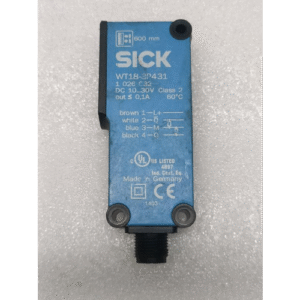
SICK WTE11-2P1132 458 866 PHOTOELECTRIC SENSOR 10-30VDC 100MA 4-PINS 5304549 C 110A
₹10,536.00
| Product Conditioned | NEW |
|---|
Free Shipping apply to all orders over $199
Guaranteed Money Back in 30 days return.
24/7 Customer Support
Share:
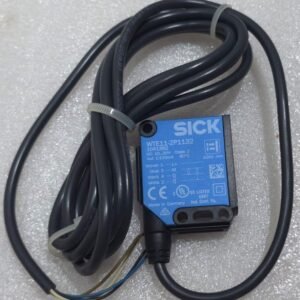 SICK WTE11-2P1132 458 866 PHOT...
₹10,536.00
2 in stock
Hotline Order:
(+101) 5620 - 8155
Email ID:
xstore@support.com
SICK WTE11-2P1132 458 866 PHOTOELECTRIC SENSOR 10-30VDC 100MA 4-PINS 5304549 C 110A
Key Product Description
-
Function: A photoelectric sensor that uses a light beam to detect the presence or absence of an object. The polarized filter allows it to reliably detect shiny, reflective objects (like metal packaging) without false triggers, which is a key advantage over standard retro-reflective sensors.
-
Typical Applications: Detecting objects on conveyor belts, in packaging machinery, material handling, and assembly automation. Ideal for detecting reflective surfaces.
Technical Specifications (from the code and standard WTE11 data)
-
Operating Principle: Polarized Retro-reflective
-
The sensor emits a light beam to a dedicated reflector (corner-cube reflector). The beam is polarized on transmission. The reflector “depolarizes” the beam. The sensor’s receiver only accepts the depolarized reflected light, ignoring direct reflections from shiny objects.
-
-
Power Supply: 10-30 VDC
-
Standard industrial DC voltage range, compatible with PLC and common DC power supplies.
-
-
Current Consumption: ≤ 100 mA
-
The maximum load the sensor itself will draw from the power supply.
-
-
Output Type: The “-1132” suffix is crucial. For SICK WTE11 series, this typically means:
-
1 x PNP, NO (Normally Open) switching output + 1 x PNP, NO (Normally Open) “Teach-In” or “Diagnostic” output.
-
Output Function: The main output switches on when an object is detected (light beam interrupted). The second output can often be used for remote parameter setting (Teach-In) or as a separate diagnostic signal (e.g., signal strength indicator). Consult the manual for the exact function of the second output.
-
Max. Load Current: Likely 100 mA per output (standard for this series).
-
-
Electrical Connection: 4-pin M12 quick-disconnect connector.
-
Pinout (Typical for WTE11 PNP with dual outputs):
-
Pin 1: +V (Power Supply +)
-
Pin 2: Output 2 (Teach-In / Aux)
-
Pin 3: 0V (Power Supply -)
-
Pin 4: Output 1 (Main Switching Output)
-
-
Always verify with the sensor’s datasheet label.
-
-
Housing: Compact, cylindrical barrel shape typical of the WTE11 series.
-
Sensing Range: For polarized retro-reflective WTE11 models, the standard sensing range is typically up to 2.5 meters or 4 meters, depending on the exact variant. Refer to the label for the precise “Sxxx” range code.
-
Light Source: Usually a visible red LED or laser red LED for easy alignment.
-
Indicator LEDs:
-
Green LED (PWR): Power indication.
-
Yellow LED (OUT): Output switching status.
-
Multi-color/Function LED: Often used for signal strength or Teach-In status.
-
-
Features:
-
Teach-In Function: Allows easy setting of the switching threshold via a button or remote input (often using the second output pin).
-
High environmental immunity: Resistant to ambient light interference.
-
Fixed Cable or Connector Version: The “-2P1132” suggests a fixed cable version. The “C 110A” on your code likely indicates a 1100mm (1.1m) cable length.
-
Breakdown of Your Full Code:
-
WTE11-2P1132: Core product model (Polarized Retro-reflective, PNP dual output).
-
458 866: Internal SICK article number or manufacturing code.
-
5304549 C: Likely a specific lot, software, or regional variant code.
-
110A: Almost certainly denotes the cable length and type → 1100mm, PUR cable, AWG 20.
We're here when you need us
Get a Quick Quote
Complete our online form.
Call US
Speak to one of our team.
Live Chat
Send us a message
Speak to one of our team.