- AUTOMATION EQUIPMENT
- DIGITAL CONTROL
- ELECTRICAL ITEMS
- AMPLIFIER & UPS
- BATTERY CHARGER & INVERTER
- CIRCUIT BREAKER & BLOCKS
- CONTROL UNIT
- ELECTRIC CONTROLLERS
- FIRE ALARAM SYSTEM
- FUSES & CAPACITOR
- HEADPHONE & SPEAKER
- HMI & DISPLAY
- MISC ELECTRICAL
- PCB
- PLC SYSTEMS
- POWER SUPPLY
- PRINTER & CPU
- RELAY
- SENSORS
- SERVO DRIVES & MOTORS
- TELECOME & COMMUNICATION
- THERMOSTAT
- MACHINERY
- SENSORS
- UNCATEGORIZED



Hotline Order:
(+91) 97257 54777
Email ID:
shipnavstore@gmail.com

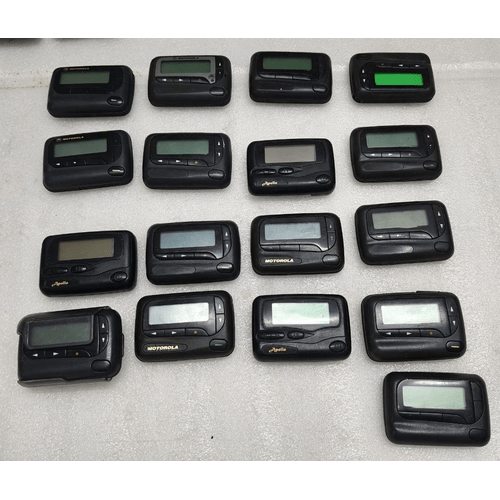
LOT 16 OF PAGER MIX APOLO, MOTOROLA PAGENET TESTED 16:33
$199.00
| Product Conditioned | USED |
|---|
You are not buying functional communication devices. You are buying a box of tested, vintage electronic collectibles and props with value rooted in nostalgia and hobbyism, not utility. The price for the entire lot of 16 should reflect this.
Free Shipping apply to all orders over $199
Guaranteed Money Back in 30 days return.
24/7 Customer Support
Share:
 LOT 16 OF PAGER MIX APOLO, MO...
$199.00
Out of stock
Hotline Order:
(+101) 5620 - 8155
Email ID:
xstore@support.com
This is a mixed lot of 16 pagers, consisting of models from the Apolo and Motorola (Pagenet) brands. These are classic radio frequency (RF) pagers, also known as beepers, from the 1980s or 1990s. They represent a significant era in pre-cellular mobile communication, widely used by doctors, technicians, and businesses.
-
Apolo: A well-known brand of pagers that was often used on various paging networks.
-
Motorola Pagenet: This is the most specific and valuable part of the description. Motorola was the dominant manufacturer of pagers, and PageNet (also written as PageNet) was the largest paging network in the United States. Pagers made for this network are iconic from this period.
Key Features & Significance
-
Vintage Technology: These are not modern devices. They are relics of the late 20th century, featuring monochrome LCD screens, simple button interfaces, and durable plastic casings.
-
Tested: This is the most important keyword. It means the seller has powered them on and confirmed that they electronically “beep” and/or light up. This does NOT mean they can receive messages on the original network. It simply confirms basic electronic functionality.
-
Display Types: The lot likely contains a mix of:
-
Numeric Pagers: Can receive phone numbers to call.
-
Alphanumeric Pagers: Can receive short text messages (more desirable).
-
-
Collectibility: Vintage pagers have a growing niche market among:
-
Tech Nostalgia Collectors: People who collect historic communication devices.
-
Retro Enthusiasts: Used for fashion, art projects, or as props in films and theater productions set in the 80s/90s.
-
Electronics Hobbyists: The internal components (LCDs, speakers, motors for vibration) can be salvaged for other projects.
-
Critical Considerations & What “Tested” Really Means
-
Networks are Defunct: The original paging networks these devices operated on (like PageNet) have been shut down for decades. These pagers cannot be used for their original purpose of receiving messages.
-
“Tested” Definition: “Tested” typically means the seller inserted a battery and confirmed the device powers on, emits a beep, the screen lights up, and/or the vibrator motor works. It is a test of basic electronics, not network functionality.
-
Condition: “Tested” does not mean “like new.” Expect signs of wear: yellowing plastic (a process called bromination), scratched screens, worn buttons, and faded labels. The battery contacts may be corroded and require cleaning.
-
Batteries: They will almost certainly not include the specific rechargeable battery packs that were required for these models. You will need to source these separately if you want to power them on, which can be difficult and expensive.
Potential Value & Assessment
The value of this lot is not in its function as a communication device but as a collection of vintage items or for parts.
-
As a Collectible Lot: A buyer is purchasing 16 pieces of tech history. The value is per unit as a collectible, typically in the $5 – $20 per pager range, depending on model, condition, and desirability. The Motorola PageNet models are generally more sought-after than the Apolo ones.
-
For Parts/Repair: A hobbyist might buy the lot to cannibalize working parts from some to repair others.
-
As Props: A theater group or filmmaker might buy the lot to outfit a cast with period-accurate props.
We're here when you need us
Get a Quick Quote
Complete our online form.
Call US
Speak to one of our team.
Live Chat
Send us a message
Speak to one of our team.